
What are Incoterms 2020?
Incoterms 2020 explained in plain terms - what Incoterms are, why they matter, and a brief rundown of each of the eleven rules and when to use them.
 Johan de Grijff, Commercial Director
Incoterms - short for International Commercial Terms - are a set of standardised, three-letter trade rules published by the International Chamber of Commerce (ICC) that define who does what, who pays for what, and who carries the risk at each stage of moving goods from seller to buyer. Incoterms 2020 is the current version, in effect since 1 January 2020, and it’s the one you should be quoting on contracts and invoices today.
If you’ve ever seen “FOB Rotterdam” or “DAP Berlin” on a purchase order and wondered what it actually commits you to, this article is for you. Below we cover what Incoterms are, why they matter, and then walk briefly through each of the eleven rules in the 2020 edition.
All eleven Incoterms at a glance
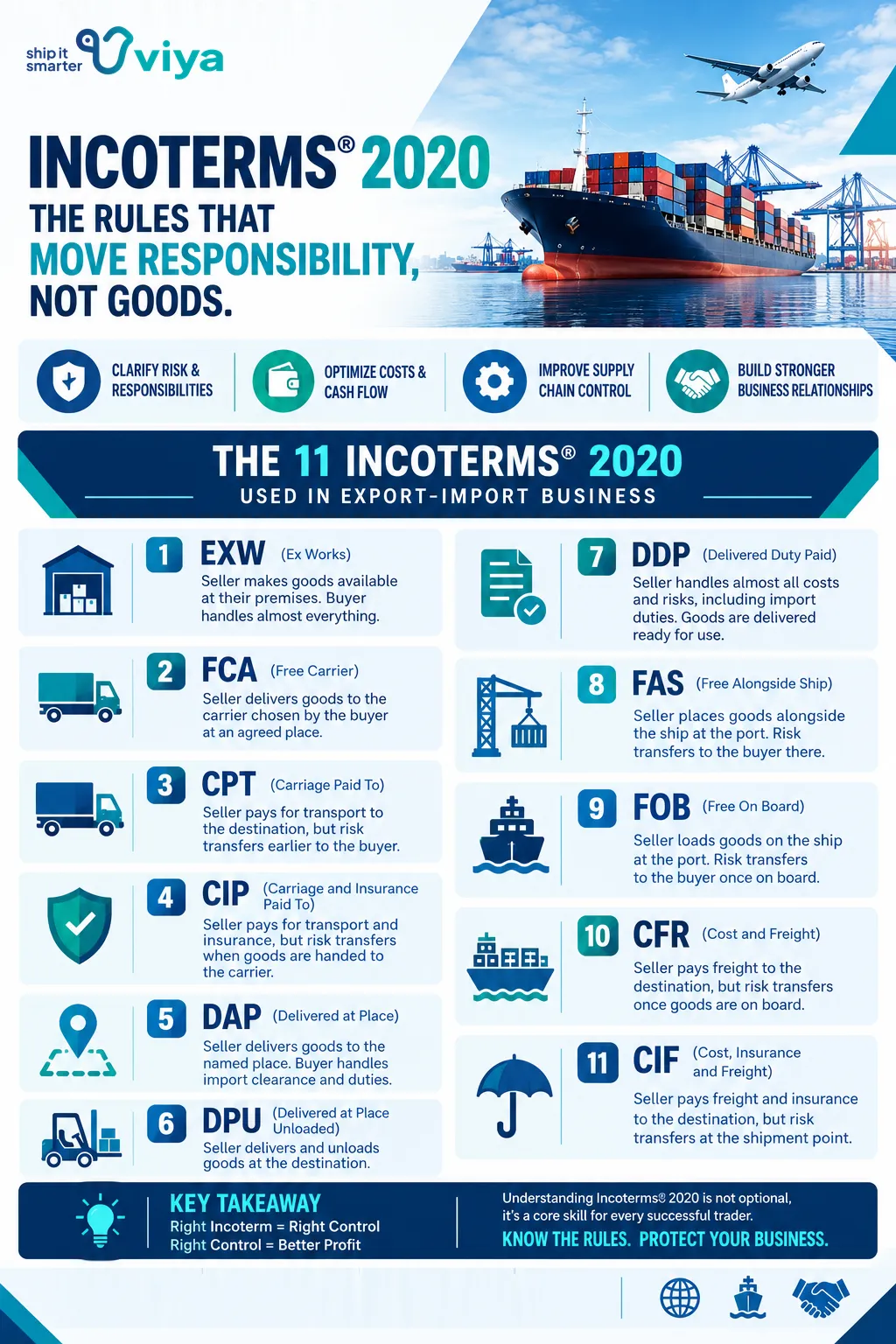
The two things that change from rule to rule are who pays for transport and where the risk passes from seller to buyer. This one-pager captures all eleven rules in a single view - keep it handy, then read on for the detail.
Rules for any mode of transport
These seven rules work for road, rail, air, sea, or any combination of them - they’re the ones to reach for with containerised and multimodal shipments. They’re listed below in order of increasing obligation on the seller, from EXW (seller does the least) to DDP (seller does the most).
| Incoterm | Where risk passes to the buyer | Seller pays main carriage? | Seller insures? | Good to know |
|---|---|---|---|---|
| EXW - Ex Works | At the seller’s premises | No | No | Maximum buyer obligation - buyer handles loading, export, transport and import. |
| FCA - Free Carrier | On handover to the buyer’s carrier | No | No | Flexible and the recommended rule for containers, replacing the misuse of FOB. |
| CPT - Carriage Paid To | On handover to the first carrier | Yes, to destination | No | Seller pays the freight, but the buyer bears the transit risk. |
| CIP - Carriage and Insurance Paid To | On handover to the first carrier | Yes, to destination | Yes - all-risks (ICC A) | Like CPT, but the seller must insure at the higher, all-risks level. |
| DAP - Delivered at Place | On arrival at the named place | Yes | No | Buyer handles import clearance and unloading. |
| DPU - Delivered at Place Unloaded | On arrival, once unloaded | Yes | No | The only rule where the seller unloads (replaced the old DAT). |
| DDP - Delivered Duty Paid | On arrival, cleared for import | Yes | No | Maximum seller obligation - the mirror image of EXW. |
Rules for sea and inland waterway transport only
These four rules assume the goods physically cross a ship’s rail or sit on a quay, so they only fit bulk or non-containerised water freight. For anything in a container, use an “any mode” rule above (FCA, CPT, CIP) instead.
| Incoterm | Where risk passes to the buyer | Seller pays main carriage? | Seller insures? | Good to know |
|---|---|---|---|---|
| FAS - Free Alongside Ship | Alongside the vessel at the origin port | No | No | Typically used for bulk cargo. |
| FOB - Free on Board | Once the goods are on board at the origin port | No | No | Only appropriate for non-containerised sea freight. |
| CFR - Cost and Freight | Once the goods are on board at the origin port | Yes, to destination port | No | Seller pays the freight but carries no insurance obligation. |
| CIF - Cost, Insurance and Freight | Once the goods are on board at the origin port | Yes, to destination port | Yes - minimum (ICC C) | Like CFR, but insured at the minimum level - a key difference from CIP. |
Choosing the right Incoterm
There’s no single “best” Incoterm - the right choice depends on the goods, the route, and how much control and risk each party is willing to take on. A few pointers:
- Match the rule to the transport mode. Use the sea-only rules (FAS, FOB, CFR, CIF) only for bulk or non-containerised water freight. For containers and multimodal shipments, prefer the “any mode” rules, with FCA as the go-to.
- Always state a named place and the year. “FCA” alone is incomplete. “FCA Rotterdam Incoterms 2020” is precise and enforceable.
- Think about who’s best placed to manage each leg. If you have strong freight rates and want control, a seller might quote CIP or DAP; if the buyer has better carriers at destination, EXW or FCA may suit better.
- Mind the customs obligations. DDP puts import clearance and duties on the seller, which can be onerous in unfamiliar markets - many sellers deliberately avoid it for exactly that reason.
Incoterms are one piece of the wider shipping puzzle. If you’re setting up transport processes and want to reduce the manual admin around bookings, documents, and carrier communication, take a look at what a TMS is, or get in touch if you’d like to talk it through.